Course Description
This micro-course explores how educators and students can end the school year with gratitude, humility, hope, and reflection through lessons drawn from the Seerah of Prophet Muhammad ﷺ and The Quran, especially Surah An-Nasr. Participants will examine how the Prophet ﷺ responded as his mission neared completion—with increased dhikr, gratitude, forgiveness, humility, and concern for others—and how these prophetic principles can transform the final days of school into meaningful moments of growth and connection.
The course provides practical classroom strategies, reflective exercises, and faith-centered activities that help teachers and students move:
- from exultation to gratitude,
- from arrogance to humility,
- and from despair to hope.
Participants will leave with actionable ideas for creating a positive, spiritually uplifting, and emotionally healthy end-of-year experience.
Key Guiding Questions
- Why are endings important in Islam?
- What does Surah An-Nasr teach us about completing a mission?
- How did the Prophet Muhammad ﷺ demonstrate empathy and gentleness with his companions?
- What is the difference between tasbih and hamd?
- Why is humility important after success?
- How can educators move students from despair to hope at the end of the year?
- What classroom practices help build gratitude and forgiveness?
- How can teachers model reflective practice and self-improvement?
- What does it mean to become a source of hope for students?
- How can the final days of school become spiritually meaningful experiences?
Learning Objectives
By the end of this course, participants will be able to:
- Explain the significance of endings in Islam using examples from the Seerah.
- Describe key lessons from Surah An-Nasr related to gratitude, humility, and repentance.
- Identify how the Prophet Muhammad ﷺ modeled empathy, gentleness, and inspirational leadership with his companions.
- Differentiate between tasbih, hamd, and istighfar and explain their relevance at the end of the school year.
- Apply prophetic principles to classroom culture and end-of-year interactions.
- Design classroom activities that cultivate gratitude, forgiveness, humility, and hope.
- Reflect on personal teaching practices and identify areas for spiritual and professional growth.
- Develop strategies for ending the school year in a way that positively impacts students emotionally, spiritually, and academically.
Course Layout
The course is divided into four modules. Each module is followed by a quiz. Students must score at least 80% on a quiz to access the next module. You may take a quiz as many times as needed. You will receive a certificate and will be able to access resources at the end of the course.
Target audiences
- School Admin
- School Staff
- Teachers
Curriculum
- 6 Sections
- 6 Lessons
- 4 Weeks
- Module 1: IntroductionEndings are very important! Prophet Muhammad (saw) is reported to have said, “Indeed, deeds are based on their endings.” In other words, our deeds are judged by Allah (swt) on how we end them. Complete the lesson and the quiz in this module to learn from the life of Prophet Muhammad (saw) on how to end the school year on a positive note.2
- Module 2: Mindset of GratitudeThis lesson highlights the importance of maintaining a mindset of gratitude during the last days of school and classroom activities teachers can do with their students to maintain that mindset.2
- Module 3: Mindset of HumblenessAnother lesson from Surah An-Nasr that we can apply in our classrooms during the last days of school is to focus on creating a mindset of humbleness instead of boastfulness and arrogance as we celebrate the year’s successes and achievements.2
- Module 4: Mindset of HopeThe third and last lesson from Surah An Nasr that we can apply in our classrooms during the last days of school is the importance of creating a hopeful mindset instead one of despair and classroom activities teachers can do to give hope to their students as we end the school year.2
- Activity: EOY Self-Assessment and PlanUse the 'Key Questions for EOY" for self-assessment and to make a plan for the last days of school.1
- Course Evaluation1
FAQs
Certificate
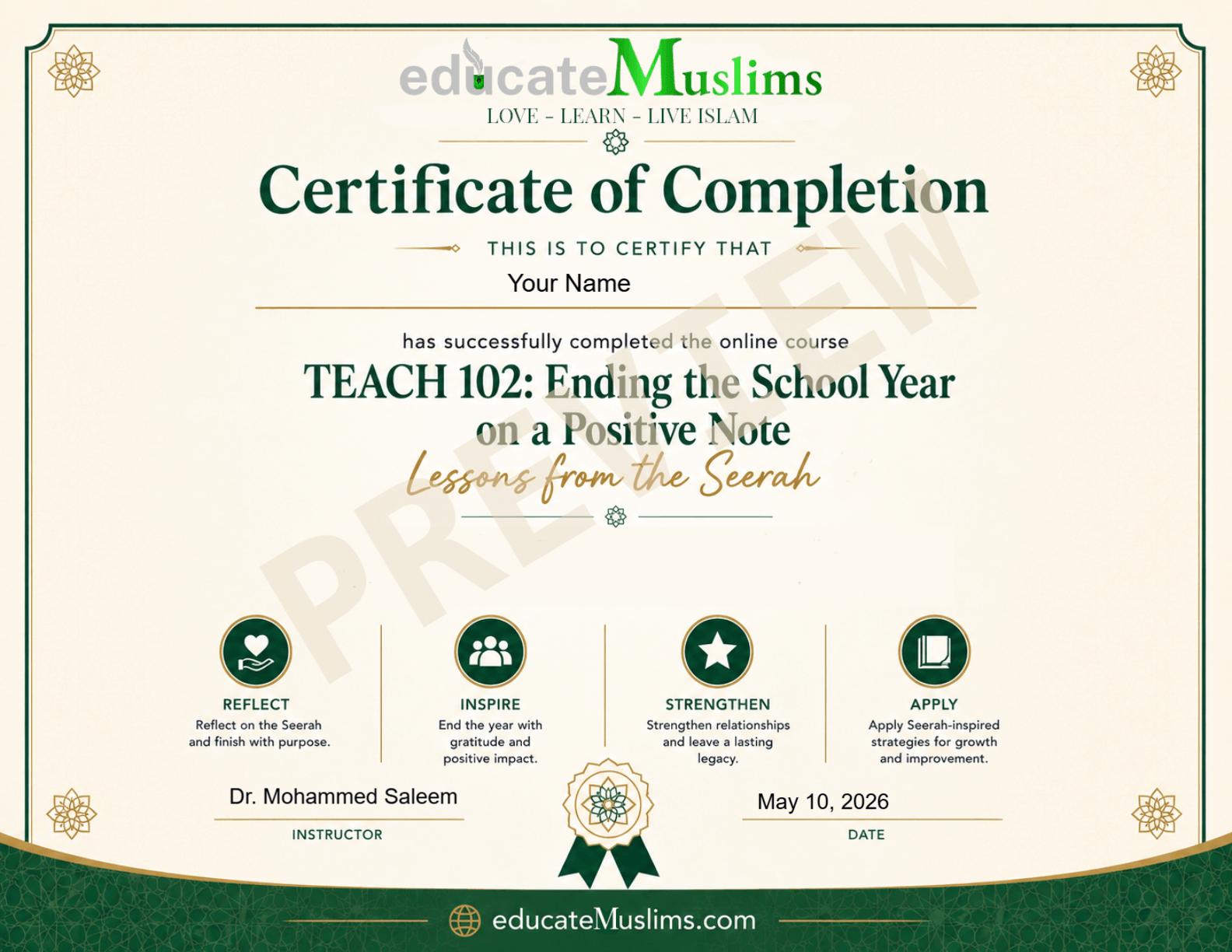
Complete the course to receive this certificate with your name on it.
Instructor

Mohammed Saleem has spent over two decades in educating Muslim children in US and Canada as a certified teacher, principal, and a faculty member. He has a bachelor’s in education, a masters in education administration, and a doctorate in curriculum and instruction. He currently works as a principal of a full-time Islamic school in Canada. You may view his complete profile on his website at https://experteacher.wixsite.com/drsaleem